
Showing posts with label Research. Show all posts
Showing posts with label Research. Show all posts
Saturday, 1 April 2017
Age certificate
The certificate we have decided to use for our film opening is a '15'. This is because our film would contain imitable behaviour which could be dangerous for younger viewers to witness. Also, some of the scenes may be quite disturbing and as the psychological aspect is a clear theme throughout it wouldn't be appropriate for a younger audience.
 We didn't make it a 12 due to the fact that the plot incorporates violence and different states of mind. However, we didn't make it an 18 as there are no reoccurring sexual or criminal themes. It also does not contain any strong language. Also, as our target audience is teenagers/young adults this certificate seems most appropriate.

Saturday, 12 November 2016
BFI [British Film Institute] study trip
On the 11th November we attended a study day at the BFI on the Southbank. For the first half, a media teacher called Tom Woodcock gave us tips and more information on our film opening coursework. He covered many areas including lighting, editing, incorporating titles etc.
He taught us about Macro conventions which include genre, narrative, character, themes and atmosphere. He also taught us about Micro conventions which include colour, lighting, props, font, framing and setting.
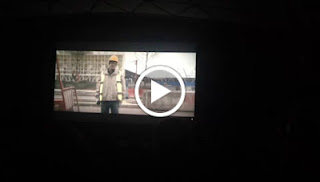
We watched some film openings including Napoleon Dynamite, Casino Royale and The wedding singer. We had to think about the macro and micro elements. This gave us some inspiration and an insight into what we had to include and think about when creating our film openings.
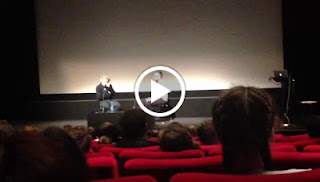
After Tom Woodcock finished his presentation on conventions of film openings, he introduced us to Dexter Fletcher who is an actor who has appeared in both film and television and is now a successful director. First, he spoke about his experiences and struggles he had to overcome in filming and Tom Woodcock interviewed him then he showed us openings of some of his films; this included 'Eddie the Eagle' and 'Wild bill' He then did a live question and answer session where we could ask him for some tips and advice for our coursework.

He taught us about Macro conventions which include genre, narrative, character, themes and atmosphere. He also taught us about Micro conventions which include colour, lighting, props, font, framing and setting.
We watched some film openings including Napoleon Dynamite, Casino Royale and The wedding singer. We had to think about the macro and micro elements. This gave us some inspiration and an insight into what we had to include and think about when creating our film openings.
After Tom Woodcock finished his presentation on conventions of film openings, he introduced us to Dexter Fletcher who is an actor who has appeared in both film and television and is now a successful director. First, he spoke about his experiences and struggles he had to overcome in filming and Tom Woodcock interviewed him then he showed us openings of some of his films; this included 'Eddie the Eagle' and 'Wild bill' He then did a live question and answer session where we could ask him for some tips and advice for our coursework.


Friday, 4 November 2016
Art of the titles
Using artofthetitle.com i found the following movie openings. This is good research for what we are going to produce as a group as it provides us with some inspiration. There are many openings on this site so i have included the ones that stood out to me and a brief explanation of why that was.
Cargo - innocence lost
As a group we have decided to focus on this opening. This is because it falls within the same genre that our film opening is going to fall under. We found the shaky use of the camera very clever as it portrays how the woman is feeling. Something that we took from this clip specifically is the idea of huffing and puffing which can be seen in the Cargo clip at 2:20. We are gong to take this idea and use it in our own way.
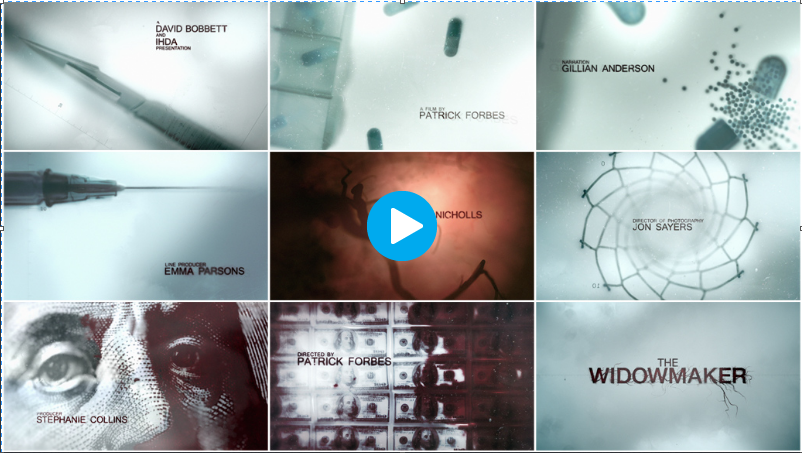
The widowmaker:
I like how the opening involves a lot of close ups of objects that add a mystery atmosphere. This includes needles, a close up of a face, pills etc. We are thinking of including close ups of tablets in our opening so this is quite related. However, in general i like how they incorporated a lot of close ups to give hints for the film.

Silent hill:
The use of handwriting shows us that the film could be quite mysterious and different as normally the titles are very well structured. This is something i liked as it isn't typical for a film like this, it breaks out of what is expected. The lack of colour also gives us an edgy and dark atmosphere for the film as everything blends together as it is all black and white.This lets us suspect that the film is going to be a horror and have quite a gloomy atmosphere.

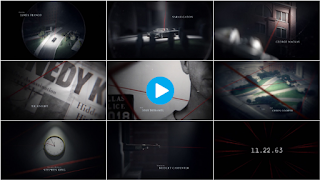
11.22.63
This film opening uses a strong presence of audio to build up the atmosphere. A few hints are given through the images as it explores the location and a man who will probably be the main character. There are sharp cuts to the next item that is being shown each time but the audio helps everything link together which shows the strength of incorporating relevant audio to aid the titles.
Les bleus de ramville
This title sequence stands out from the rest for me as the titles are fitting with the images moving behind them. The colour and position of the titles suit with the background each time in order to incorporate the titles with the sequence starting to build up. This is to make sure there isn't a harsh division between the titles and the film starting. This may seem simple and easy to achieve however it has a great impact on the title sequence.

Cargo - innocence lost
As a group we have decided to focus on this opening. This is because it falls within the same genre that our film opening is going to fall under. We found the shaky use of the camera very clever as it portrays how the woman is feeling. Something that we took from this clip specifically is the idea of huffing and puffing which can be seen in the Cargo clip at 2:20. We are gong to take this idea and use it in our own way.
The widowmaker:
I like how the opening involves a lot of close ups of objects that add a mystery atmosphere. This includes needles, a close up of a face, pills etc. We are thinking of including close ups of tablets in our opening so this is quite related. However, in general i like how they incorporated a lot of close ups to give hints for the film.
The use of handwriting shows us that the film could be quite mysterious and different as normally the titles are very well structured. This is something i liked as it isn't typical for a film like this, it breaks out of what is expected. The lack of colour also gives us an edgy and dark atmosphere for the film as everything blends together as it is all black and white.This lets us suspect that the film is going to be a horror and have quite a gloomy atmosphere.

11.22.63
This film opening uses a strong presence of audio to build up the atmosphere. A few hints are given through the images as it explores the location and a man who will probably be the main character. There are sharp cuts to the next item that is being shown each time but the audio helps everything link together which shows the strength of incorporating relevant audio to aid the titles.

Les bleus de ramville
This title sequence stands out from the rest for me as the titles are fitting with the images moving behind them. The colour and position of the titles suit with the background each time in order to incorporate the titles with the sequence starting to build up. This is to make sure there isn't a harsh division between the titles and the film starting. This may seem simple and easy to achieve however it has a great impact on the title sequence.

Wednesday, 21 September 2016
Camera shots and angles
Camera shots:
- Establishing

- Long shot

- Full shot

- Midshot

- Close up

- Extreme close up

Camera angles:
- Eye level

- Low angle

- High angle

- Overhead shot

- Under shot

Subscribe to:
Posts (Atom)